相似性困扰我很久了。为什么所有圆都有相同的面积公式——我们怎么知道当它们变大时不会发生什么隐藏的事情?在物理学中,当将物体(粒子、昆虫、小孩)缩放到巨大尺寸时,难道不会发生奇怪的事情吗?你是说每个圆都有相同的公式,但一只300英尺的蜜蜂无法飞行?
关键在于:
相似形状是彼此缩放后的版本。因为我们无法区分它们(继续阅读以了解原因),所以它们必须具有相同的内部公式用于面积、周长等。
然而,具有相同公式的物品并非可互换!当然,所有人类(从儿童到 NBA 球员)都有“臂展=身高”的公式。没错——但这意味着一个7英尺的大脚怪和我18英寸的侄子同样擅长篮球吗?
我的“啊哈!”时刻是将通用公式(臂展=身高)与个别实例的适用性(婴儿 vs. 大脚怪)分离开来。
为什么缩放后的物体具有相同的公式
思想实验帮助我意识到,在确定一个公式是否能适用于某个形状的所有实例时,绝对大小并不重要。一个见解是,对“大小”的感知通常是由我们观察者决定的,而不是形状本身。
视野
想象一张纸上的三角形。它在你的视野中占据一定空间——比如说,30%。
Now, move closer to the paper, so the triangle takes up most of your view — say, 90%. What changed? The triangle is the same, but the sides appear much bigger. Yet we know that the core properties (area, perimeter, etc.) haven’t changed — otherwise, we’d need to know someone’s distance from a triangle when calculating area!

创建管道
This time, imagine a paper circle. Now, thicken the paper until you make a cylinder (of equal diameter) extending into the distant horizon. The part of the cylinder a few feet off “looks” to be 1/2 the size of the disc before you, yet you know they are the same size. The ratios inside (circumference to diameter, area to radius, etc.) must be the same also.

Photoshop缩放
Imagine a triangle on a computer screen. Make all sorts of formulas for area, perimeter, and so on. Now, zoom the triangle by 300% and measure again. What changed? Sure, everything was bigger on the second measurement, but does the triangle “know” it’s being zoomed and change itself to make the formulas different?
测量单位
Suppose you’re measuring ratios on a shape with your trusty ruler. You have your table full of figures: area to perimeter, diagonal to side, and so on. But whoops! It looks like you had written “cm” when you were actually measuring the sides in inches.
Do you need to redo your table because you were using the wrong unit? Does the shape know what units you’ve been using?
引入物理学
My conundrum started when remembering a factoid from biology class: Godzilla couldn’t exist because he would overheat. Big lizards can’t do the same things little lizards can.
为什么?
For simplicity, let’s assume Godzilla is a lizard cube. For any cube of side “s”, the volume is s3, and the surface area is 6 * s2.
Now, let’s assume that heat generated is proportional to volume (essentially your mass), and cooling is proportional to surface area (amount of skin you have exposed to that cool, breezy air). How much cooling do you have for each unit of girth mass?
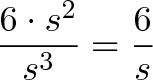
For every unit of volume, we have 6 / s “surface area units” available to cool it. If s = 1cm (for example), then we have 6 / 1 = 6 square centimeters to cool ourselves for each cm3 of volume. Great.
But what if s = 10cm? Uh oh. Now we have 6 / 10 = .6 square centimeters of cooling. And if s = 100cm we only have .06 sq cm of cooling. At some point, our cooling cannot balance our heat requirements and Godzilla falls over. (Suppose he needs at least .1 square cm of cooling for each cubic cm to stay alive).
Remember our insight:
- 秒3, 6 * s2, 以及 6 / s 是所有立方体中常见的模式,无论其大小
- 6 / 1 = 6, 6 / 10 = .6, 6 / 100 = .06 是 特定实例 “表面积与体积”公式的一部分。有些满足我们的热量需求,有些不满足。
If you’re interested, there are other 结构性问题 with a lizard of that magnitude.
例子比比皆是
The idea of finding patterns in similar shapes (and separating them from specific examples) is ubiquitous in math and the sciences. Here’s a few examples of “similarity” which often aren’t labeled as such.
发现Pi
Pi is the most famous example of similarity — all circles share the same ratio (circumference / diameter = pi). Again, no matter how much we zoom to make one circle appear like another, every circle has this fundamental trait.
球体物理学
A sphere is the most space-efficient shape — it gives the most volume for the least surface area. No matter if you’re an elephant or mouse, you’ll conserve the most heat by curling into a ball.
Planets and raindrops are spherical because of these unique properties — even though the scale difference for each example is enormous.
三角学(Trigonometry)
正弦(Sine)、余弦(Cosine)以及三角家族的其他成员都基于角度。由于大小无关紧要(45度角的边长需要多长?没关系!),角度非常适合处理相似性。
因为具有相同角度的三角形是相似的,我们可以使用其中一个三角形内部的比值(即单位圆内的三角形),然后按比例缩放结果以适应我们需要的任何例子。
算法运行时间
算法的运行时间 [O(n), O(n*log(n)), O(n2), 等] 基于找到一个描述运行时间的“相似类”。一个 O(n2) 的算法在输入数量翻倍时,运行速度应该慢4倍。
然而,对于 具体实例,所需的算法可能不同:用 O(n3) 算法运行10个输入可能比用 O(n) 算法运行1000万个输入更快。
面向对象编程
在编程中,同一个类(“相似类”!)的成员可能共享公式,如 $Area = \pi r^2$。然而,每个 实例 该类实例可能具有不同的“r”值。该类提供了通用模式,而实例提供了细节。
总结思考
几点观察:
- 将通用公式与特定形状的实例分开。所有圆都是相似的,但大披萨比小披萨更好,对吧?
- 类比有助于记忆。关于婴儿 NBA 球员和“哥斯拉立方体”的一些愚蠢提醒,使“模式与例子”的概念更加清晰。
- 相似性的概念比几何学更广泛——它关乎识别具有相同内部属性的项目类别。
相似性的实际定义更为微妙;你可以反过来理解,如果基于距离的公式总是相同(它们是均匀 缩放 缩放或膨胀的),则形状是相似的。但是,这些是改天再讨论的有趣话题——祝你数学愉快!