
Limits, the Foundations Of Calculus, seem so artificial and weasely: “Let xapproach0, but not get there, yet we’ll act like it’s there… ” Ugh.
Here’s how I learned to enjoy them:
- What is a limit?对我们未观测到的点的最佳预测。
- How do we make a prediction?放大到邻近的点。如果无论我们放大多少,我们的预测总是处于邻近点之间,那就是我们的估计值。
- Why do we need limits?数学中有“黑洞”场景(除以零、趋于无穷(Infinity)),而当无法直接计算结果时,极限(Limit)给我们一个估计值。
- How do we know we’re right?我们不需要。我们的预测,即极限(Limit),并不要求与现实相符。但对于大多数自然现象来说,它似乎确实如此。
Limits let us ask “What if?”. If we can directly observe a function at a value (like x=0, or x growing infinitely), we don’t need a prediction. The limit wonders, “If you can see everythingexcepta single value, what do you think is there?”.
When our prediction isconsistent and improves the closer we look, we feel confident in it. And if the function behaves smoothly, like most real-world functions do, the limit is where the missing point must be.
Key Analogy: Predicting A Soccer Ball
Pretend you’re watching asoccer game. Unfortunately, the connection is choppy:

Ack! We missed what happened at 4:00. Even so, what’s your prediction for the ball’s position?
Easy. Just grab the neighboring instants (3:59 and 4:01) and predict the ball to be somewhere in-between.
And… it works! Real-world objects don’t teleport; they move through intermediate positions along their path from A to B. Our prediction is “At 4:00, the ball was between its position at 3:59 and 4:01”. Not bad.
With a slow-motion camera, we might even say “At 4:00, the ball was between its positions at 3:59.999 and 4:00.001”.
Our prediction is feeling solid. Can we articulate why?
The predictions agree at increasing zoom levels. Imagine the 3:59-4:01 range was 9.9-10.1 meters, but after zooming into 3:59.999-4:00.001, the range widened to 9-12 meters. Uh oh! Zooming shouldnarrowour estimate, not make it worse! Not every zoom level needs to be accurate (imagine seeing the game every 5 minutes), but to feel confident, there must be some threshold where subsequent zooms only strengthen our range estimate.
The before-and-after agree.Imagine at 3:59 the ball was at 10 meters, rolling right, and at 4:01 it was at 50 meters, rolling left. What happened? We had a sudden jump (a camera change?) and now we can’t pin down the ball’s position. Which one had the ball at 4:00? This ambiguity shatters our ability to make a confident prediction.
With these requirements in place, we might say “At 4:00, the ball was at 10 meters. This estimate is confirmed by our initial zoom (3:59-4:01, which estimates 9.9 to 10.1 meters) and the following one (3:59.999-4:00.001, which estimates 9.999 to 10.001 meters)”.
Limits are a strategy for making confident predictions.
Exploring The Intuition
Let’s not bring out the math definitions just yet. What things, in thereal world, do we want an accurate prediction for but can’t easily measure?
What’s the circumference of a circle?
Finding pi “experimentally” is tough: bust out a string and a ruler?
We can’t measure a shape with seemingly infinite sides, but we can wonder “Is there a predicted value for pi that is always accurate as we keep increasing the sides?”
阿基米德figured outpi 有一个范围,介于
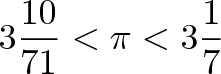
使用类似这样的过程:
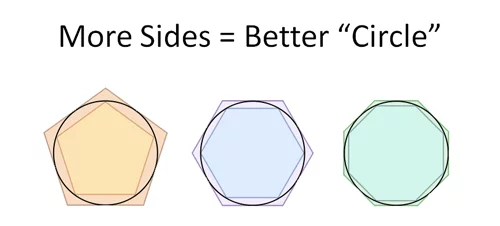
这是微积分的前身:他确定 pi 是一个始终介于他不断缩小的边界之间的数。如今,我们拥有现代的limit definitions of pi.
What does perfectly continuous growth look like?
e,我的其中一个favorite numbers,可以这样定义:
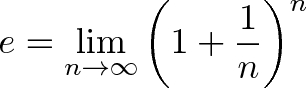

我们无法轻易测量无穷复利增长的结果。但是,如果我们could make a prediction,是否存在一个始终准确的单一速率?它似乎约为 2.71828……
Can we use simple shapes to measure complex ones?
圆和曲线难以测量,但矩形很容易。如果我们could使用无穷多个矩形来模拟曲线面积,我们能否得到一个经得起无穷检验的结果?(也许我们可以find the area of a circle.)

Can we find the speed at an instant?
速度很有趣:它需要前和后的测量(行进距离 / 所花时间),但我们难道不能在单个瞬间拥有速度吗?嗯。
极限(Limit)有助于回答这个难题:当你前往相邻瞬间时预测你的速度。然后问这个“不可能的问题”:当到相邻瞬间的间隔为零时,你预测的速度是多少?
注意:极限并非万能灵药。我们不能假定极限存在,也并非每个问题都有答案。例如:整数的数量是偶数还是奇数?这个数量是无穷(Infinity)的,并且随着我们数得越来越大,“偶数”和“奇数”的预测都无法保持准确。不存在有充分支持的预测。
对于 pi、e 和微积分(Calculus)的基础,聪明的头脑做了证明,确定“是的,我们预测的值越仔细看就越准确。”现在我明白为什么极限为何如此重要:它们是我们预测上的批准印章。
The Math: The Formal Definition Of A Limit
极限是有充分支持的预测。以下是官方定义:
means for all real ε > 0 there exists a real δ > 0 such that for all x with 0 < |x − c| < δ, we have |f(x) − L| < ε
让我们把它变得可读:
| Math English | Human English |
|---|---|

|
当我们“强烈预测” f(c) = L 时,我们的意思是 |
| 对所有实数 ε > 0 | 对于我们想要的任意误差幅度(+/- .1 米) |
| 存在实数 δ > 0 | 存在一个缩放级别(+/- .1 秒) |
| 使得对所有满足 0 < |x − c| < δ 的 x,我们有 |f(x) − L| < ε | 预测在该误差范围内保持准确的地方 |
这里有一些细微之处:
- 缩放级别(delta,δ)是函数(Function)的输入,即视频中的时间
- 误差范围(epsilon,ε)是 throughout the entire zoom level 中函数(Function)输出(球的位置)与我们预测的最大可能偏差
- 绝对值条件(0 < |x − c| < δ)意味着正负偏移都必须成立,并且我们跳过了黑洞本身(当 |x – c| = 0 时)。
我们无法计算黑洞般的输入,但我们可以说“除了缺失的点,整个缩放级别都确认了预测 $f(c) = L$。”并且因为 $f(c) = L$ 对any我们能找到的误差范围都成立,我们感到有信心。
我们会有多个预测吗?假设我们为 f(c) 预测了 L1 和 L2。它们之间存在某些差异(称之为 0.1),因此存在某个误差范围(0.01)能揭示更准确的一个。该范围内的每个函数输出都不可能同时处于两个预测的 0.01 之内。我们要么有一个单一的、无穷准确的预测,要么没有。
是的,我们可以卖弄一下,要求“左极限”(事件前的预测)和“右极限”(事件后的预测),但只有当它们一致时,我们才有一个真正的极限。
当函数始终与预测值匹配时,它是连续的(否则就是不连续的):
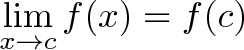
微积分通常研究连续函数,玩着“我们在做预测,但只是因为我们知道它们会正确”的游戏。
The Math: Showing The Limit Exists
我们已经具备了可靠预测的条件。问你“证明极限存在”的问题,是要求你为估计提供理由。
例如:证明在 x=2 处以下函数的极限存在
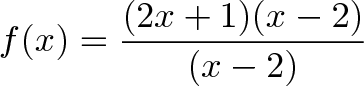
第一项检查:我们甚至需要极限吗?不幸的是,需要:直接代入“x=2”意味着我们会除以零。该死。
但直观上,我们看到相同的“零”(x – 2) 可以从分子和分母中约去。以下是对这支危险探戈的跳法:
- 假设 x 是任意位置except2(它必须是!我们是从外部进行预测的。)
- 然后我们可以约去分子和分母中的 (x – 2),因为它不为零。
- 剩下 f(x) = 2x + 1。这个函数(Function)可以在黑洞外部使用。
- 这个更简单的函数(Function)预测了什么?它预测 f(2) = 2*2 + 1 = 5。
所以 f(2) = 5 是我们的预测。但你看到狡猾之处了吗?我们假装 x 不是 2 [以约去 (x-2)],然后在那个麻烦项消失后才代入 2!这样想:我们用了来自outside the event的简单行为来预测棘手行为at the event.
我们可以证明这些花招给出了可靠的预测,并且 f(2) = 5 是无穷精确的。
对于任意精度阈值(ε),我们需要找出保持在该精度内的“缩放范围”(δ)。例如,我们能将估计值保持在 +/- 1.0 以内吗?
当然。我们需要找出

所以
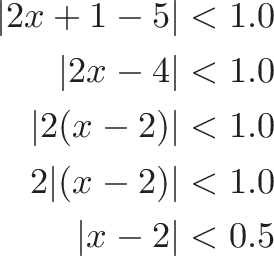
换句话说,x 必须保持在距 2 的 0.5 范围内,才能维持初始的 1.0 精度要求。确实,当 x 在 1.5 和 2.5 之间时,f(x) 从 f(1.5) = 4 到 f(2.5) = 6,始终与我们的预测值 5 相差 +/- 1.0。
我们可以通过将上面的 1.0 替换为任意误差容限(ε)来推广。我们得到:

如果我们的缩放级别是“δ = 0.5 * ε”,我们将保持在原始误差内。如果误差是 1.0,我们需要缩放到 .5;如果是 0.1,我们需要缩放到 0.05。
这个简单的函数是一个方便的示例。其思路是从初始约束(|f(x) – L| < ε)开始,代入 f(x) 和 L,然后求解距黑洞点的距离(|x – c| < ?)。这通常是一道代数练习题。
有时你被要求直接求极限(代入 2 得到 f(2) = 5),其他时候你被要求证明极限存在,即费力做 epsilon-delta 代数。
Flipping Zero and Infinity
无穷(Infinity),在极限中使用时,意味着“无休止地增长”。符号 ∞ 并不比句子“无休止地增长”或“我的内裤库存正在减少”更像一个数。它们是概念,不是数字(就我们的数学水平而言,Aleph仅我个人而言)。
在极限中使用 ∞ 时,我们是在问:“当 x 无休止地增长时,我们能否做出一个保持准确的预测?”。如果存在极限,意味着无论我们看多远,预测值总是被证实。
但是,我仍然不喜欢无穷,因为我看不见它。但我能看见零。利用极限,你可以将

重写为

你可以耍点小聪明,定义 y = 1/x,替换公式中的项,然后使用

这样它又看起来像一个普通问题了!(评论区 Tim 注:极限是从右侧来的,因为 x 是趋于正无穷的)。我更喜欢这种安排,因为我能看到我们正在收窄的位置(在画无穷版本时我们总是纸不够用)。
Why Aren’t Limits Used More Often?
想象一个小孩发现“在末尾加个零”能让数字变大 10 倍。有 5?写下“5”然后“0”即 50。有 100?变成 1000。以此类推。
他没搞清楚乘法为什么有效,为什么这条规则合理……但是,你得承认,他确实很会乘 10。当然,也有一些边界情况(0 会变成“00”吗?),但它运作得相当好。
微积分的规则是非正式地被发现的(以现代标准看)。Newton 推导出“x^3 的导数(Derivative)是 3x^2”而没有严格证明。然而引擎转动、飞机飞行都基于他非官方的成果。
微积分教学的错误在于制造像“你必须先懂极限™才能欣赏微积分”这样的路障,而显然微积分的发明者并不需要。我更倾向于这样的进程:
- 微积分(Calculus)提出看似不可能的问题:矩形何时能测量曲线?我们能检测瞬时变化吗?
- 极限(Limit)为回答“不可能”的问题提供了策略(“如果你能做出一个经得起无穷(Infinity)审视的预测,我们就认为它可行。”)
- 它们是一对绝佳的组合:微积分(Calculus)探索,极限(Limit)验证。我们记住用极限(Limit)验证过的结果的捷径($\frac{d}{dx} x^3 = 3x^2$),就像我们记住用乘法验证过的规则的捷径一样(加个零表示乘 10)。但知道这些捷径为何合理仍然是件好事。
极限不是检验不可能问题答案的唯一工具;无穷小(Infinitesimal)也行。关键是理解what我们在尝试预测,then学习做预测的规则。
数学愉快。
本系列其他文章
- A Gentle Introduction To Learning Calculus
- Understanding Calculus With A Bank Account Metaphor
- 史前微积分:发现 Pi
- 一个微积分类比:积分(Integral)即乘法
- 微积分:建立对导数(Derivative)的直觉
- 如何理解导数:乘积法则、幂法则与链式法则
- 如何理解导数:商法则、指数与对数
- An Intuitive Introduction To Limits
- 泰勒级数的直觉(DNA 类比)
- 我们为什么需要极限和无穷小(Infinitesimal)?
- 学习微积分:克服我们对精确性的人为需求
- 一场关于 0.999... = 1 的友好讨论
- 类比:微积分相机
- 抽象练习:微积分图形
- 快速洞察:用微积分做更简单的算术
- 如何用微积分将 1 加到 100
- Sin(x) 的积分:几何直觉